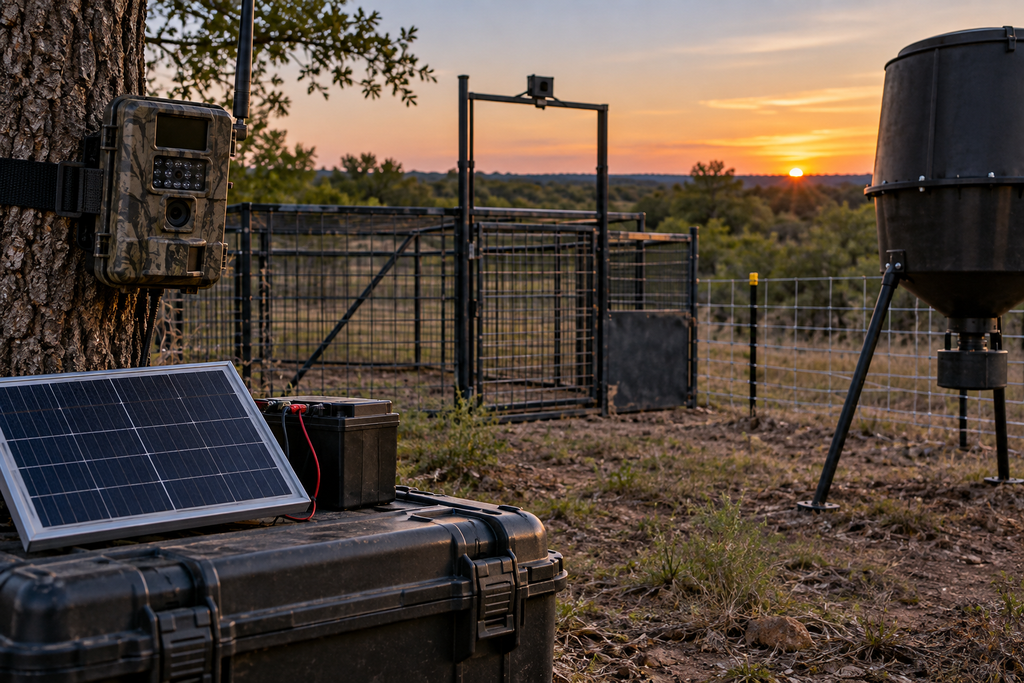
Wild-pig control depends on more than the method itself. Cameras, traps, feeders, bait systems, sensors, fencing and other field equipment help landowners and professionals detect activity, monitor movement, improve timing and support control efforts. Choosing the right tools—and using them correctly—can make management more efficient and more effective.
Cameras & Monitoring
Trail cameras and other monitoring systems help identify where wild pigs are active, how many animals may be present and when they are using a property. Cellular cameras can provide near-real-time updates, while standard cameras may be useful in areas without reliable service. Consistent monitoring can help improve trap placement, reveal changes in movement and show whether pigs remain after control efforts.
Traps & Gates
Traps range from smaller box-style systems to large corral traps designed to capture entire sounders. Gate design, trigger systems, trap size and placement all affect performance. Remote-triggered gates and camera-connected systems can give users more control over when a trap is activated, while simpler systems may be appropriate where cost, connectivity or access are limiting factors.
Feeders & Bait Systems
Feeders and bait systems can help concentrate wild-pig activity in a predictable location for monitoring or control. Timing, feeder design, bait choice and placement all influence how pigs respond. Because baiting and toxicant use may be regulated differently from state to state, landowners should confirm local requirements before using any product or system.
Sensors & Remote Technology
Remote sensors, wireless triggers and connected monitoring systems can reduce the need for constant on-site checking. These tools may alert users to pig activity, report trap status or allow certain equipment to be controlled from a distance. Their value depends on reliable power, connectivity, weather resistance and how well the technology fits the property and control strategy.
Fencing & Exclusion Equipment
Fencing and exclusion equipment can protect crops, gardens, livestock areas and other high-value locations where complete removal of wild pigs may not be practical. Options range from reinforced woven-wire fencing to electric systems and temporary barriers. Effectiveness depends on proper installation, maintenance, terrain and whether pigs can root underneath or push through weak points.
Power & Field Support Equipment
Many monitoring and control systems depend on reliable field power and support equipment. Solar panels, batteries, mounting hardware, weatherproof enclosures and backup power can help keep cameras, gates, feeders and sensors operating in remote locations. Equipment should be matched to the site conditions and checked regularly so a failed battery or damaged connection does not interrupt monitoring or control efforts.
Choosing Equipment for the Job
The best equipment depends on the size of the property, the number of pigs present, terrain, connectivity, budget and the control method being used. More technology is not always better. A simple, reliable setup that fits the property and can be maintained consistently may outperform a more complicated system that is difficult to operate or keep powered.
Maintenance & Reliability
Field equipment is only useful when it continues to work. Cameras, gates, feeders, sensors and power systems should be checked regularly for battery condition, weather damage, signal strength, loose connections and physical wear. Routine maintenance can prevent missed activity, failed captures and unnecessary downtime, especially in remote locations where problems may otherwise go unnoticed.
Sources & Further Reading
USDA APHIS — Feral Swine Resources — technical guides and national management resources.
USDA APHIS — Managing the Damage — trapping, fencing and other control methods.
Mississippi State University Extension — Wild Pig Info — practical information on traps, cameras, baiting and field management.