Effective wild-pig control usually requires more than a single method. Trapping, exclusion, hunting and other management approaches each have strengths and limitations, and the best results often come from matching the method to the property, pig behavior, local regulations and the scale of the problem.
Trapping
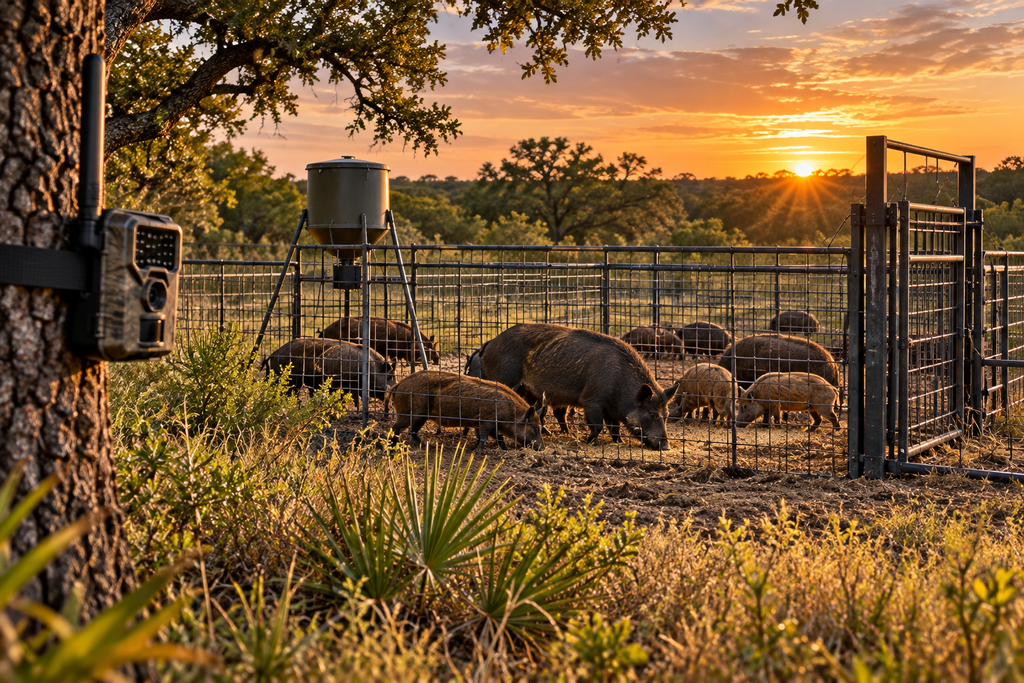
Trapping is one of the most widely used methods for removing wild pigs, particularly when entire sounders can be captured at once. Success depends on identifying active areas, pre-baiting when appropriate, monitoring pig activity and allowing the group to become comfortable entering the trap before it is triggered. Trap design, placement and timing can make a major difference in how many pigs are removed and how quickly remaining animals become trap-shy.
Exclusion & Fencing
Exclusion can be effective where protecting a specific crop, pasture, garden, facility or sensitive habitat is more practical than removing every pig from the surrounding area. Fencing must be strong enough to resist rooting and pushing, and gates, corners and low points require particular attention. Electric fencing and reinforced barriers may improve protection, but cost, terrain, maintenance and the size of the area all affect whether exclusion is practical.
Hunting & Shooting
Hunting and shooting can remove individual wild pigs and may be useful in areas where trapping is impractical or where only a small number of animals remain. However, repeated hunting pressure can change pig behavior, increase nighttime activity and cause groups to disperse into surrounding areas. For larger populations, hunting is often most effective when used as part of a broader control program rather than as the only method.
Integrated Control
Integrated control combines two or more methods so that each addresses a different part of the problem. A landowner might use cameras to identify activity, trapping to remove a sounder, fencing to protect a high-value area and targeted shooting for remaining animals. The goal is not to use every method, but to build a coordinated approach based on the property, the number of pigs present and how they respond to pressure.
Choosing the Right Method
The most appropriate control method depends on the size of the property, the number of pigs present, the type of damage occurring, available resources and local regulations. What works well on a large ranch may not be practical on a small farm or suburban property. Before acting, landowners should identify the problem clearly, confirm which methods are legal in their area and choose an approach that can be maintained long enough to produce meaningful results.
Monitoring Results & Follow-Up
Wild-pig control rarely ends with a single removal effort. Continued monitoring with cameras, tracks, rooting and other signs can show whether pigs remain or return to the property. Follow-up is especially important after partial removal because surviving animals may change their movement patterns or become more difficult to capture. Effective management means checking results, adjusting methods when needed and responding quickly when new activity appears.
Sources & Further Reading
USDA APHIS — Managing the Damage — integrated control methods, fencing, trapping, ground removal and the need to account for local regulations.
USDA APHIS — Feral Swine Resources — technical guides and national management resources.
Mississippi State University Extension — Wild Pig Info — practical trapping, hunting and landowner-management guidance.