Wild pigs create far-reaching economic, agricultural, environmental and animal-health impacts. Their damage can affect crops, pastures, property, native habitat, livestock, wildlife and public resources, while disease and parasite risks add another layer of concern. Understanding the full scale of these impacts helps explain why effective wild-pig management requires sustained attention at both the local and national level.
Economic Cost
The economic impact of wild pigs reaches far beyond damaged crops. USDA APHIS currently estimates a minimum of $3.4 billion in annual feral-swine damage in the United States, while ongoing research estimates about $2.5 billion each year in agricultural damage and control costs alone. These losses can include destroyed crops and pasture, livestock impacts, damaged fencing and equipment, property repairs, control expenses and recurring losses when pigs return to an area.
Agriculture & Property
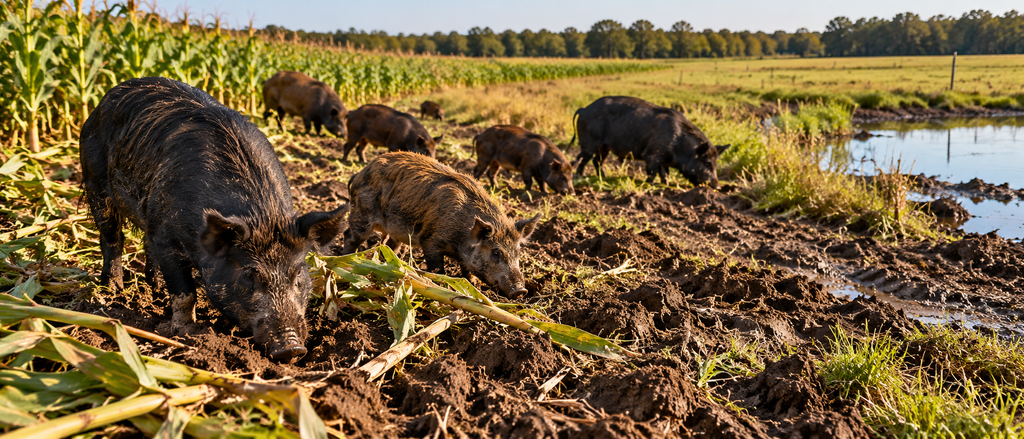
Wild pigs can damage crops, pastures, lawns, irrigation systems, fencing, roads and other property through rooting, trampling and feeding. Agricultural losses can occur quickly when pigs concentrate in a field, while repeated activity may create longer-term problems such as soil disturbance, erosion and damaged infrastructure. Because pigs often move across property boundaries, damage can return even after a local control effort if surrounding populations remain.
Disease & Biosecurity
Wild pigs can carry at least 30 viral and bacterial diseases and nearly 40 parasites that may affect people, pets, livestock and wildlife. USDA surveillance focuses on diseases of particular concern to animal agriculture, including classical swine fever, African swine fever, foot-and-mouth disease, pseudorabies and swine brucellosis. Biosecurity matters because disease risk increases where wild pigs come into contact with domestic animals, feed, water sources or contaminated environments.
Environmental Damage
Wild pigs can disturb soil, damage wetlands and forests, reduce plant regeneration and compete with native wildlife for food and habitat. Rooting and wallowing can increase erosion, alter water quality and damage sensitive ecosystems, while predation on eggs, reptiles, amphibians and other small animals can add further pressure to native species. In areas with repeated pig activity, the environmental effects can extend well beyond the immediate signs of rooting or trampling.
Why Coordinated Management Matters
Wild pigs do not recognize property, county or state boundaries, so isolated control efforts may provide only temporary relief. Effective long-term management often depends on coordination among landowners, wildlife professionals, agricultural agencies, researchers and neighboring properties. Sharing information about sightings, damage, control activity and recurrence can help communities respond earlier, target resources more effectively and reduce the chance that pigs simply move from one unmanaged area to another.
Sources & Further Reading
USDA APHIS — Feral Swine Damage: Pets and Peoplehttps://www.aphis.usda.gov/operational-wildlife-activities/feral-swine/damage-people-pets
USDA APHIS — Feral Swine Damage: Natural Resourceshttps://www.aphis.usda.gov/operational-wildlife-activities/feral-swine/damage-natural-resources
USDA APHIS — National Feral Swine Damage Management Programhttps://www.aphis.usda.gov/operational-wildlife-activities/feral-swine/program