Wild pigs are highly adaptable animals whose movement, feeding, reproduction and social behavior directly affect how they are detected and controlled. Understanding how they use habitat, respond to pressure and move across the landscape is the foundation of effective management
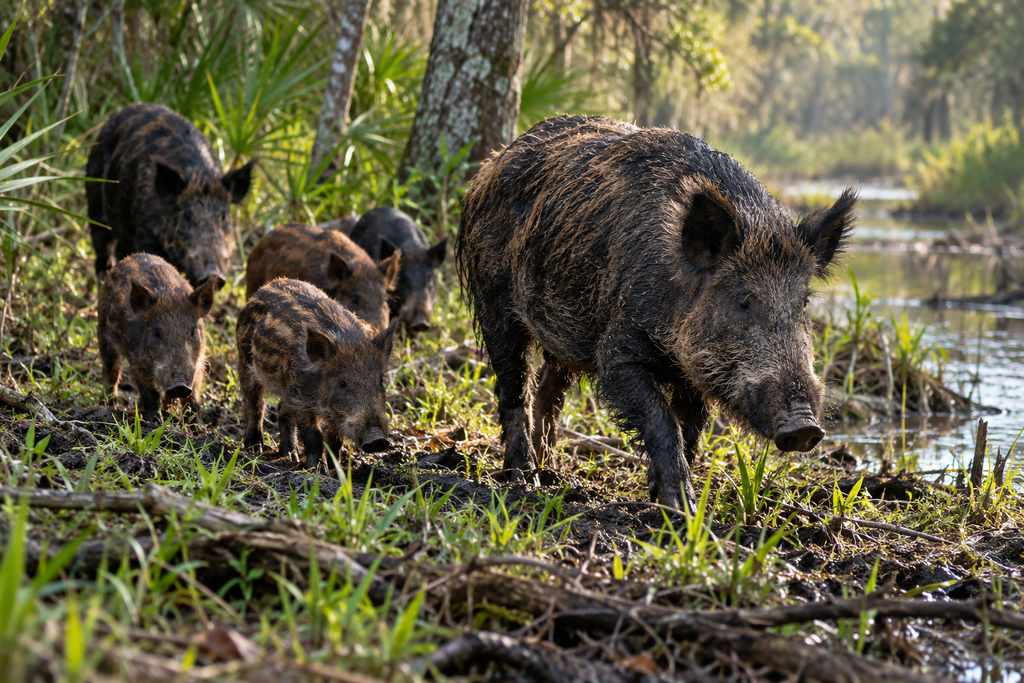
Movement & Habitat
Wild pigs use forests, wetlands, agricultural land, pastures and other areas where food, water and cover are available. They often travel along creek bottoms, fence lines, trails and other natural corridors, and their movements can change with weather, food availability and human pressure. In heavily disturbed areas they may become more active at night, making fresh sign and camera observations especially useful for locating them.
Feeding Behavior
Wild pigs are opportunistic omnivores and will eat a wide range of plant and animal material. Their diet can include roots, tubers, mast, crops, insects, eggs, small animals and carrion. Feeding patterns change with the season and with what is locally available, so damage may shift quickly from one field or habitat to another. Fresh rooting, feeding damage and repeated camera activity can help identify where pigs are concentrating.
Social Structure
Wild pigs are social animals. Females and their young commonly live in family groups called sounders, which may include several related females and multiple generations of offspring. Adult males are more often solitary, especially outside the breeding period. Understanding whether activity comes from a sounder or a single boar matters because effective control often depends on removing the entire group rather than only a few individuals.
Reproduction
Wild pigs reproduce rapidly when food, water and shelter are favorable. Females can breed at a young age, and litters may contain several piglets. Because multiple females within a sounder may reproduce, local populations can grow quickly after only partial removal. This is one reason control programs often focus on removing whole sounders and preventing surviving pigs from reestablishing the group.
Signs & Evidence
Wild pigs leave distinctive signs that can reveal where they are feeding, traveling and resting. Common evidence includes rooted soil, tracks, wallows, rubs on trees or posts, scat, damaged crops and disturbed fencing. No single sign proves how many pigs are present, but fresh evidence combined with trail-camera observations can help identify active areas and guide monitoring or control efforts.
When They’re Active
Wild pigs can be active at any time, but their activity often shifts with temperature, hunting pressure and human disturbance. In quieter areas they may move during daylight, while heavily pressured populations often become more nocturnal. Trail-camera records, fresh tracks and recent feeding damage can help determine when pigs are using a property and when control efforts are most likely to encounter them.
What This Means for Control
Wild-pig behavior changes with habitat, food, season and human pressure, so effective control usually requires observation before action. Knowing where pigs travel, when they are active, whether you are dealing with a sounder or a solitary boar, and where fresh damage is occurring can make trapping, exclusion, hunting and other control methods more targeted and effective.
Sources & Further Reading
- USDA APHIS — Identifying Feral Swine — biology, reproduction, sounders, activity patterns and signs of presence.
- USDA APHIS — Feral Swine Resources — technical guides and national management resources.
- Mississippi State University Extension — Wild Pig Info — biology, damage and management information for landowners.